AERODYNAMICS & MECHANICS · JEZERO CRATER

Why a Drone Flies on Mars

Newton’s three laws explain almost every movement of a Mars drone, from generating lift in ultra-thin Martian air to hovering, accelerating across Jezero Crater, and sticking the landing.

ATMOSPHERIC METRICS & VEHICLE DATA JPL-SPEC INGENUITY-M2020
Mars gravity
~38% of Earth’s gravity (3.72 m/s²)
Drone / Vehicle
Ingenuity Helicopter (1.8 kg ultralight mass)
Location
Jezero Crater (Airfield Wright Brothers Field)
Atmospheric Density
~0.015 kg/m³ (<1% of Earth’s air density)
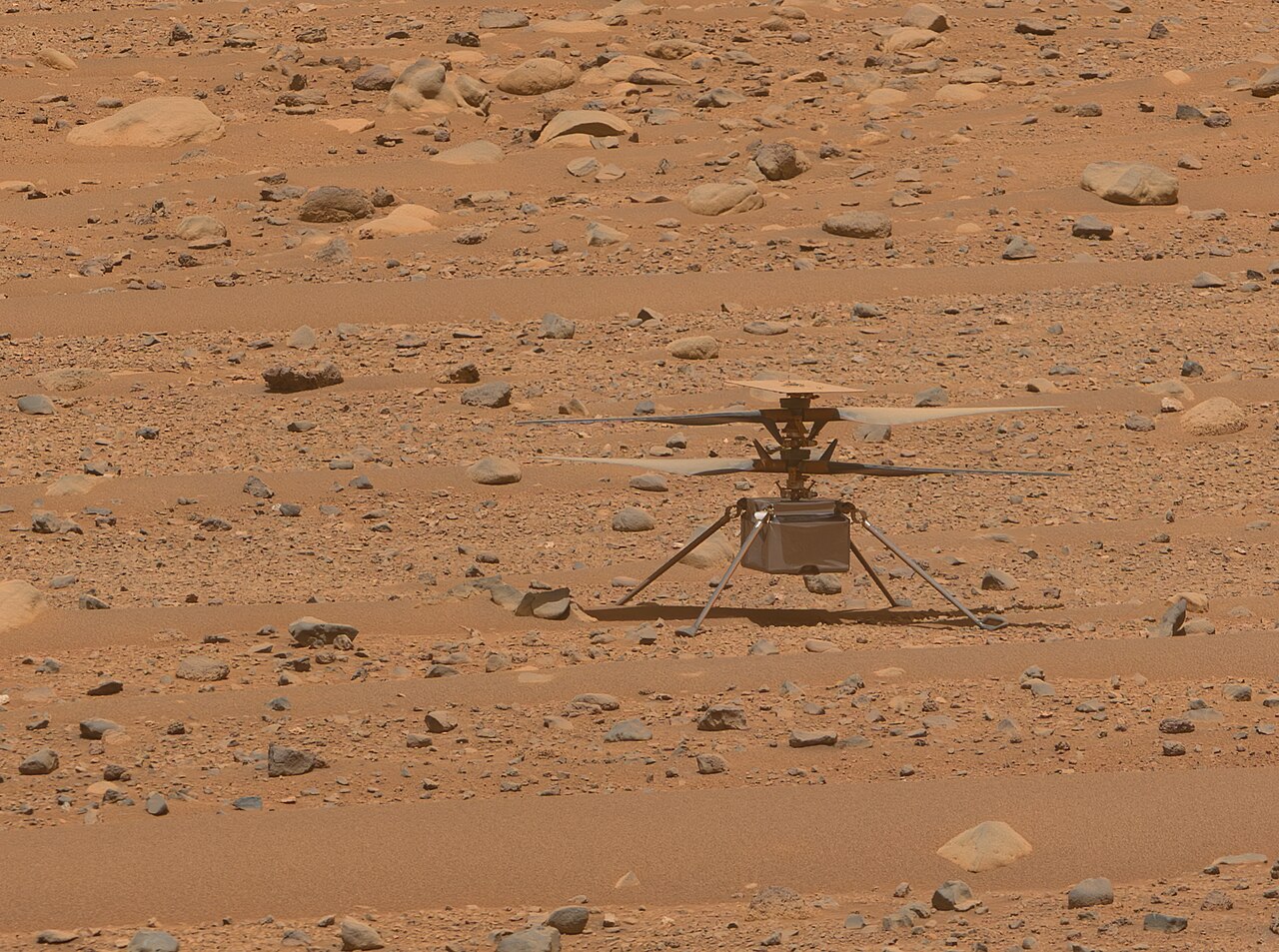
NASA Ingenuity Mars Helicopter resting on the red regolith surface of Jezero Crater on Mars
FIGURE 0.1 Ingenuity Mars Helicopter standing on the surface of Jezero Crater, photographed by Perseverance Mastcam-Z on Sol 768. Credit: NASA / JPL-Caltech / MSSS / ASU
LAW 01

01 — An object keeps doing what it’s doing

“An object at rest stays at rest, and an object in motion stays in motion unless a force acts on it.”

Ingenuity does not simply float into the air on its own. While parked on its four carbon-fiber landing legs in Jezero Crater, gravitational pull pulls it downward with a weight force of W = 6.70 N (1.8 kg × 3.72 m/s²). The Martian ground pushes back upward with an equal normal force of 6.70 N. The net external force is zero, so the drone remains stationary at rest.

To begin climbing, Ingenuity’s dual brushless DC motors spin its carbon-fiber blades to over 2,400 RPM, creating an upward aerodynamic thrust that exceeds its weight (Thrust > 6.70 N). This unbalanced net force breaks equilibrium, accelerating the drone upward off the surface.

Once at its target flight altitude, Newton’s First Law governs the steady hover: the flight computer throttles the rotors so that upward thrust matches downward gravity precisely (Thrust = Weight). Because the net vertical force is again zero (ΣF = 0), the drone maintains a constant altitude with zero vertical acceleration.

KEY PRINCIPLE · INERTIA IN HORIZONTAL FLIGHT

Because Mars’ atmosphere is less than 1% as dense as Earth’s, atmospheric drag on the drone is extremely weak. Once Ingenuity accelerates forward, its inertia would cause it to keep coasting indefinitely across the crater floor. To stop, the flight computer must actively tilt the rotor disk backward to produce an opposing horizontal braking force.

TEXTBOOK SCHEMATIC · FREE-BODY FLIGHT STATES STATE A: REST ON SURFACE
MARTIAN SURFACE (JEZERO CRATER AIRFIELD BED) 1.8 kg N = 6.7 N (Ground) W = m·g = 6.70 N Thrust T = 9.5 N VELOCITY v = 0.00 m/s (ΣF = 0)
LAW 02

02 — More force means more acceleration

F = ma or rearranged: a = F_net / m

Newton’s Second Law defines the relationship between net external force (Fnet), inertial mass (m), and acceleration (a). Because acceleration equals net force divided by mass (a = F / m), reducing mass is the most effective way to maximize responsiveness.

This single equation dictated Ingenuity’s entire design. In Mars’ thin atmosphere, generating rotor thrust is extraordinarily difficult. NASA engineers kept the drone’s total mass down to an astonishing 1.8 kilograms.

In vertical flight, two opposing forces act along the vertical axis: upward rotor thrust (T) and downward Martian gravity (W = mg = 6.70 N). The net force determines vertical acceleration:

F_net = Thrust - Weight = Thrust - 6.70 N
a = (Thrust - 6.70 N) / 1.8 kg
CRITICAL PHYSICS NOTE · GRAVITY VS. INERTIA

Mars' lower gravity (~38% of Earth) is what makes flight possible at all: Ingenuity only needs 6.70 N of lift to overcome gravity on Mars, compared to 17.66 N on Earth.

However, the drone’s inertial mass remains exactly 1.8 kg. When tilting horizontally to sprint across Jezero Crater at 10 m/s, horizontal acceleration still follows a_x = F_x / 1.8 kg—independent of local gravity.

INTERACTIVE LABORATORY · THRUST → DRONE → VERTICAL ACCELERATION SIMULATOR ACTIVE
NET VERTICAL FORCE (T - W) +1.80 N
÷
DRONE MASS (m) 1.8 kg
=
VERTICAL ACCELERATION (a) +1.000 m/s²
ALTITUDE: 0 m (SURFACE) ALTITUDE: 5 m (CRUISE) ALTITUDE: 10 m (PEAK ASCENT) 1.8 kg W = 6.7 N T = 8.5 N +1.00 m/s²
8.50 Newtons
FLIGHT MODES:
STATUS: READY · ALTITUDE: 0.00 m
LAW 03

03 — Every push has a push back

“For every action, there is an equal and opposite reaction.”

Forces in nature always occur in matched interaction pairs. An object cannot push on something without that same thing pushing back with an equal and opposite force.

How does a drone generate lift in an atmosphere? Many people assume a helicopter simply “sucks itself up.” In physical reality, aerodynamic lift is an explicit Newton’s Third Law action-reaction pair between the rotor blades and atmospheric gas molecules:

  • 1
    Action: The angled, spinning carbon-fiber rotor blades push Martian atmospheric gas molecules downward (Fblades on air), creating high-velocity downwash.
  • 2
    Reaction: The accelerated Martian gas molecules push upward against the blades with an equal and opposite force (Fair on blades = Aerodynamic Lift).

This explains why a drone cannot fly in a vacuum. Without atmospheric molecules to accelerate downward, no reaction force can exist to lift the drone! Because Mars’ air is 100 times thinner than Earth’s, Ingenuity must push a huge volume of air downward each second—requiring 1.2-meter wide carbon-fiber blades spinning at an extreme 2,400 to 2,700 RPM.

THE ROTATIONAL THIRD LAW · COAXIAL ROTORS

Newton’s Third Law also applies to torque. When the motor spins the top rotor clockwise, the rotor pushes back on the drone body counter-clockwise with equal torque! To prevent the body from violently spinning out of control, Ingenuity uses two counter-rotating rotors: the bottom rotor spins counter-clockwise at the same speed, creating an equal and opposite reaction torque that cancels the first.

ACTION-REACTION PAIR · ROTOR AIRFOIL DOWNWASH CROSS-SECTION VIEW
MARTIAN ATMOSPHERE (ρ ≈ 0.015 kg/m³ · 95% CO₂) High-Velocity Downwash Air Stream Leading Edge Blade Velocity (2,500 RPM) ACTION: Blade pushes air downward REACTION: Air pushes blade upward (Lift)
VEHICLE ARCHITECTURE & LAWS IN PRACTICE

Physics, millions of kilometres away

When Ingenuity lifts off across Jezero Crater, all three laws act simultaneously in every aerodynamic subsystem. Click any component below to inspect how physics governs its flight on Mars.

INGENUITY · SUBSYSTEM BREAKDOWN CLICK LABELS TO INSPECT PHYSICS
AVIONICS · 1.8 kg ROTOR BLADES MOTORS & CONTROL FUSELAGE (1.8 KG) LANDING LEGS
SUBSYSTEM 01 / AERODYNAMIC LIFT

Coaxial Rotor Blades (Dual 1.2 m Disks)

Ingenuity employs two counter-rotating 1.2-meter diameter rotors made of carbon-fiber skins wrapped around a lightweight foam core. Spinning at 2,400 to 2,700 RPM, they force thin carbon-dioxide molecules downward (Action) so the air pushes the blades upward (Reaction). The counter-rotating design cancels torque reaction so the drone does not spin.

Rotor Span 1.2 meters
Spin Rate 2,400–2,700 RPM
Construction Carbon-fiber composite
PHYSICAL SUMMARY

The Laws at a Glance

I FIRST LAW

Motion changes when an external force acts.

Ingenuity rests stationary on the Martian surface until rotor thrust exceeds its 6.70 N weight, and hovers at a constant altitude when upward thrust precisely balances gravity (ΣF = 0).

II SECOND LAW

Force, mass, and acceleration are connected.

Because Ingenuity’s mass is engineered down to just 1.8 kg, modest net forces (F = Thrust - Weight) produce rapid vertical and horizontal accelerations via a = F / m.

III THIRD LAW

Forces always come in interacting pairs.

Upward aerodynamic flight occurs solely because the spinning blades force thin Martian air downward, while counter-rotating blades cancel motor reaction torque.

AERONAUTICS AT 225 MILLION KILOMETRES

Why Newtonian Mechanics Matter to Flight Engineers

Autonomous Closed-Loop Flight Control

With a 5 to 20-minute radio lag from Earth, joystick piloting is impossible. Ingenuity’s onboard flight computer runs a 500 Hz control loop: an inertial measurement unit (IMU) senses instantaneous accelerations (a = F/m), continuously adjusting blade pitch to balance forces in real time.

Atmospheric Thinness & Rotor Physics

In air density equivalent to Earth at 30,000 meters altitude (higher than commercial airliners), every gram matters. To generate the Third Law reaction force needed for lift, blade tips spin at Mach 0.7 relative to the cold, thin Martian atmosphere.

Precision Touchdown (Zero-Velocity Landing)

Upon landing, flight software throttles thrust to allow gravity to produce a controlled negative acceleration, cutting motor power the split-second the legs detect contact with Martian soil to prevent tipping.